
Secure
You're comfortable with both intimacy and independence. You trust your partner, communicate openly, and aren't afraid of being left.
Relationship anxiety & rumination
Unread-able chat history, replayed conversations, auto-jumping to the worst—relationship anxiety often hides underneath. Most of the time it points to anxious attachment.
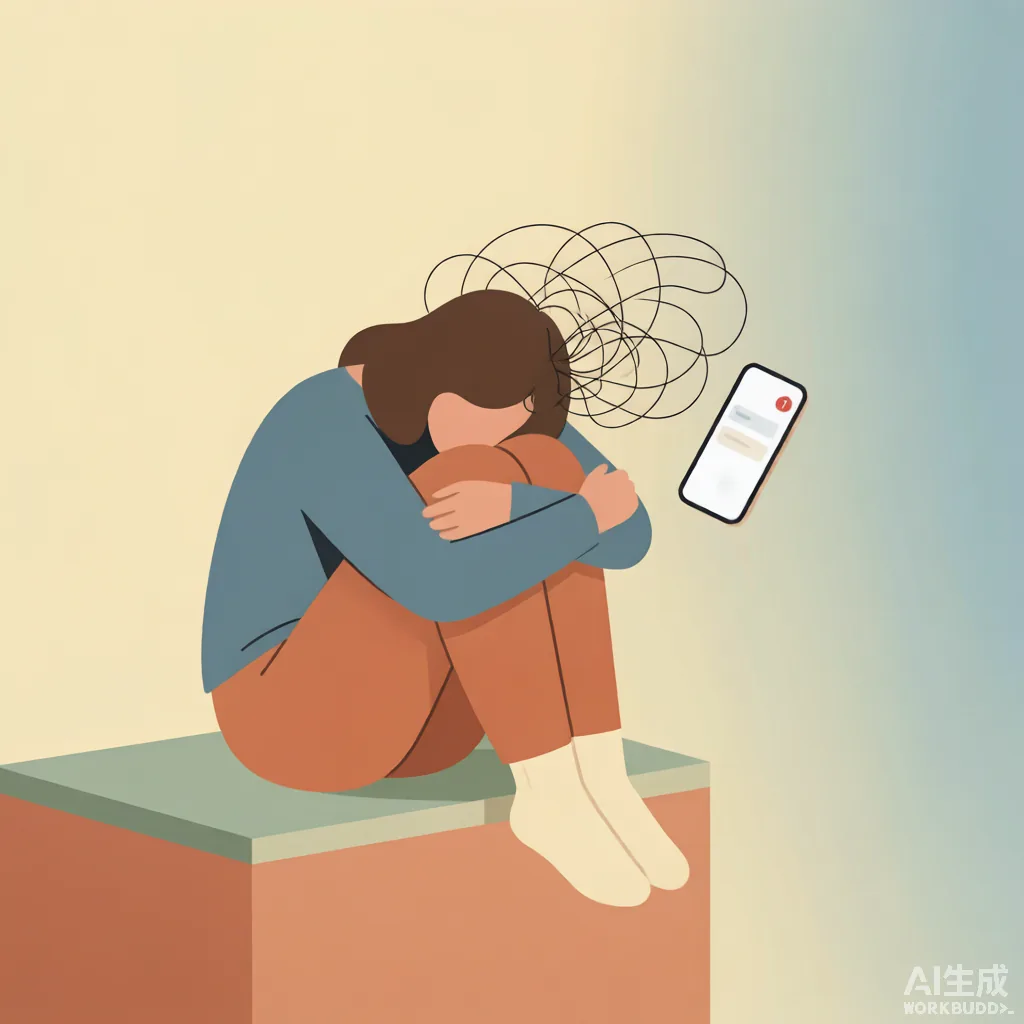
By 2 a.m., I'd looked at his post forty times
It was just a piano clip — no @, no tag. But that night I dug up things even he wouldn't remember and turned them into a story.
Just past two in the morning, I scrolled onto a short piano video he posted that afternoon. No @, no mention. The cover was his back — he'd told me he was learning piano lately.
I started matching from the beginning: how long had he been practicing? For me, or for someone else? When he said the other week 'I'm picking something up' — was that it? I read every comment, then opened a piano piece he'd liked three months ago and listened.
He was already asleep. I'd planned to bring it up naturally tomorrow morning — but the more I tried to sound casual, the more it sounded like someone who'd already looked forty times.
He said 'sure' — and it took me three days to ask
Two letters, by anyone else, mean nothing. For someone still chewing on a sentence, every word can be unwrapped into three more.
Monday night I suggested a new place. He said 'sure.' No period.
That night I started unwrapping it: 'sure' as in 'agreed,' or 'sure' as in 'let's drop it'? No emoji — neutral, or cold? I scrolled back through my noon-long message for any line that might have crossed him.
For two days I acted like nothing was wrong. Each reply he gave, I was silently parsing it word by word. Thursday on the way home I finally asked: 'were you tired that night?' He stared, completely blank — he'd long forgotten.
Relationship anxiety is that constant background voice: 'what if.' You reread a late reply, read a neutral tone as trouble, and hunt for hidden meaning in every sentence.
This isn't a character flaw—it's your nervous system scanning for threat, because 'closeness' has made you uneasy before. For most people it maps to anxious attachment: connection is both important and fragile.
Four Attachment Styles
Attachment theory describes four ways of connecting with others. The test shows you where you stand on all four.
You're comfortable with both intimacy and independence. You trust your partner, communicate openly, and aren't afraid of being left.

You crave closeness but often worry you aren't loved enough. You need repeated reassurance, and distance makes you uneasy.

You highly value independence and feel uneasy with too much closeness; you're used to relying on yourself.

You want intimacy yet fear getting hurt, caught in a tug-of-war between leaning in and pulling away.
Everything you need to understand your pattern—and actually grow from it—is right here.
Questions follow a validated attachment-theory framework, so your result reflects how you actually relate—not a random guess.
Most people finish in about three minutes—no long forms, no friction, anytime, anywhere.
Your answers live only in your own browser. No sign-up, no personal data collected.
Get a clear type plus practical steps to help you build a more secure way of relating.
Every attachment test on the site is completely free, with no hidden paywall.
Take the test and read your results in plain language that turns theory into advice you can use right away.
No fluff—one clear path from question to insight.
Honestly answer a set of relationship scenarios. There are no right answers—the more honest, the more useful.
Your answers map onto four dimensions—secure, anxious, avoidant, fearful—to find your dominant type.
Get a clear result and practical advice, and move step by step toward a more secure attachment.
“I finally realized I'm not 'being needy'—my anxious side was sounding the alarm.”
“My partner and I took the test together and, for the first time, we had a shared language.”
“It turns out I push people away because my avoidant side is protecting me.”
“Three minutes told me more than half a year of scrolling posts.”
Naming the anxiety is the first crack that lets it loosen.
Start Test